
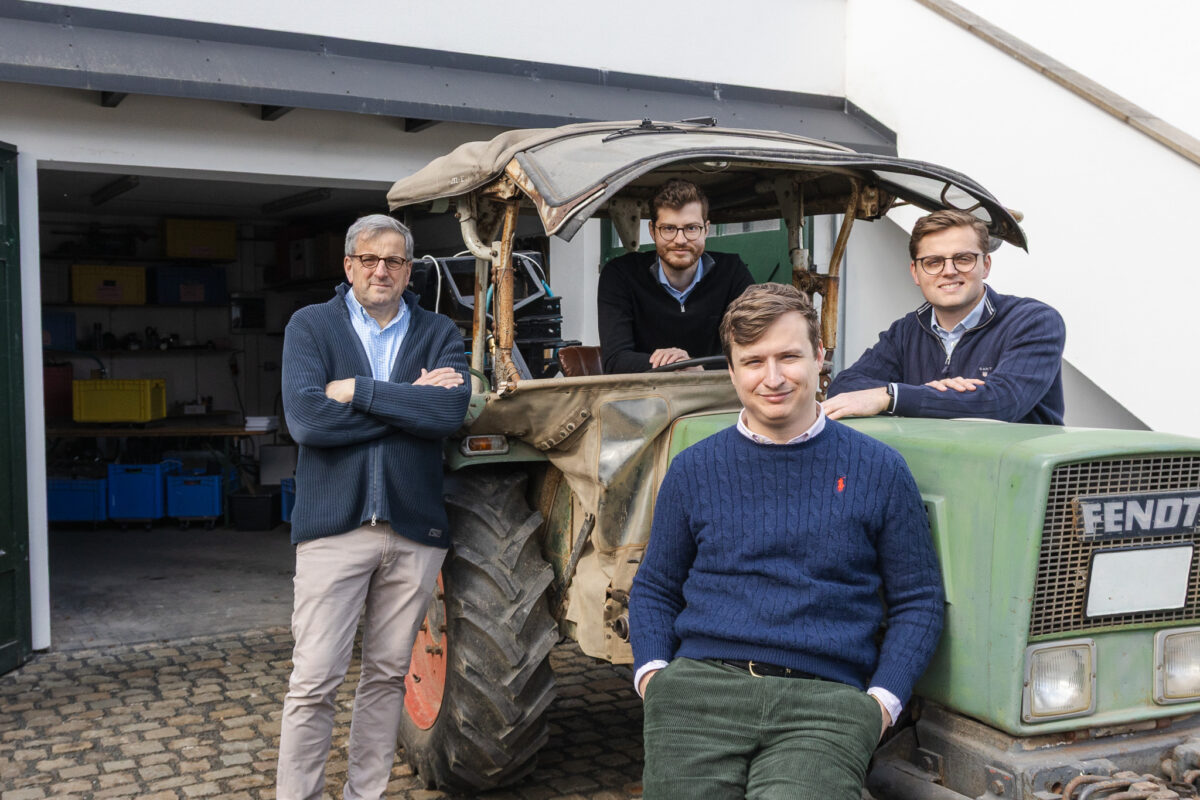
April 1st, 2026 marks the official beginning of aerotill.
What started as an engineering idea around a simple physical problem — friction between soil and steel — is now becoming a company: four people, a workshop, patent-pending technology, and the support of the German exist programme behind us. At aerotill, we are developing a new approach to soil tillage. Our system injects air through precision openings in the plow body, creating a thin lubricating layer between soil and steel. The goal is straightforward: reduce traction force, lower fuel consumption, and decrease mechanical wear during tillage operations.
The challenge we are working on is not a small one. Soil cultivation remains one of the most energy-intensive processes in arable farming. Every percentage point of reduced resistance directly translates into lower diesel consumption, reduced emissions, and less stress on machinery. Yet the underlying mechanics of tillage equipment have barely changed for decades.
We think there is room for a fundamentally different approach.
Why exist matters
The exist funding programme gives early-stage technology companies the opportunity to focus fully on turning research and engineering into a viable business. For aerotill, that means the ability to build prototypes, conduct field testing, develop the underlying technology further, and move from concept to application with the necessary time and resources.
Deep-tech development in agriculture is difficult by nature. Hardware cycles are long, testing conditions are demanding, and meaningful progress usually happens incrementally and under real-world conditions. EXIST creates the space to do that work properly.
Where we are starting
aerotill is currently based within the TUM Venture Labs ecosystem, surrounded by researchers, engineers, founders, and agricultural innovators working on some of the sector’s most difficult problems.
Right now, our focus is clear:
- building and refining prototypes,
- validating performance under field conditions,
- protecting the underlying intellectual property,
- and understanding how the technology can scale into practical agricultural use.
The first months will involve a lot of workshop hours, failed tests, redesigns, and field adjustments. That is part of building hardware. Especially in agriculture.
Building the future of tillage
Agriculture faces increasing pressure from every direction: rising operating costs, tighter sustainability requirements, volatile fuel prices, and the need to maintain productivity under changing environmental conditions.
We believe that improving the efficiency of core agricultural processes is one of the areas where engineering can have measurable impact.
aerotill is still at the very beginning of that journey. But as of now, the work has officially started.
We are excited to share the process openly — from prototypes and testing to setbacks, iterations, and hopefully meaningful progress along the way.
Follow along.